
Showing posts with label Canine Population and Rabies Control. Show all posts

Monday, February 11, 2013

Phase 5 - Todos Santos Clinics Start

February 11, 2013

COMMUNITY DAY
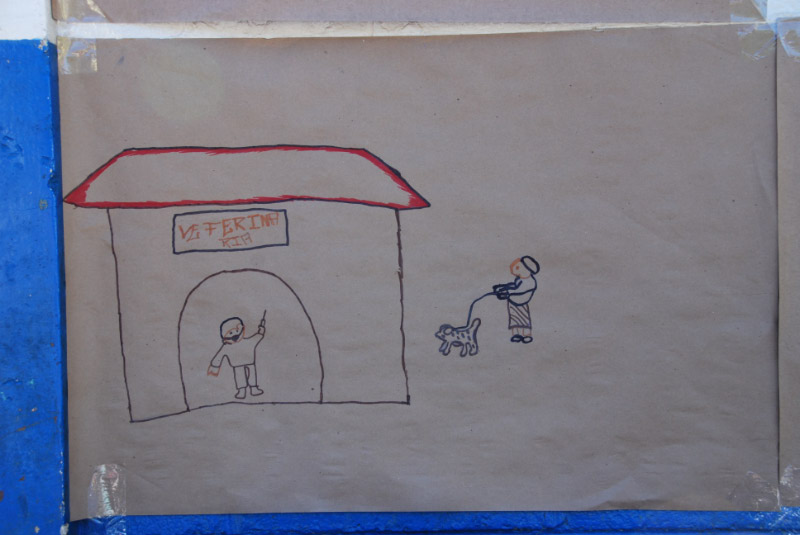
Saturday we put on the 2nd part of our community events. Friday was the school event.  Saturday is the main market day in El Centro (with a smaller market on Wednesdays) and so we wanted to provide activities for kids and their parents. We had permission to set up some activities in the Parque Centrale. It was a beautiful sunny day and once it warmed up it was lovely.  Lots of activity and the Parque was crowded. We set up outside the post office, taped up the posters the kids had drawn at the school yesterday, complete with the mistaken 'recommendation' to bathe their dogs every day!!




We had a brief announcement and a skit showing what NOT to do around strange or menacing dogs (Elena and I walking along chatting and then when seeing a strange dog, screaming and running around waving our arms vs standing quiet and still, like a tree or curling up like a rock). Then we had a lotteria (like BINGO), a bowling game, group painting and the favorite which was colouring animal masks which we would then cut out for them to wear.  It was a hectic but well-received few hours.

Guillermo DJs

Scooby made another appearance and charmed the adults as well as the kids.


The kids work hard on their masks and show them off.  The brown markers were in high demand as the kids went for realism in their colouring of the horses, cows and dogs.


A little boy poses with his chicken mask


Guillermo and a little girl in rabbit mask


Kelleigh and Janne arrive in Todos Santos

MONDAY
Natalie loads of the autoclave
Had our 1st clinic today. Patty and her group arrived about 8 o'clock last night which was great - and a big relief. They had had a long day and a half of travel leaving Toronto Saturday night and then spending about 7 hours driving in a van up to T.S. They had an incredible amount of hassle with the autoclave. Patty had had a wooden box on wheels made for the autoclave and it was enormous and heavy. They had problems leaving Toronto (as the workers in Canada won't lift more than 70 lbs - which seems bizarre to someone working in the veterinary field where we routinely lift 80-100 lb struggling, sometimes peeing and biting dogs - and it is often women doing this lifting as the veterinary field becomes increasingly female).  Finally through begging and pleading they were able to get the autoclave on the 1st plane - only to have the same problem in Houston. Finally they had the guy in charge of loading the plane come down and look to it and then he personally ensured that the autoclave made it safely on the plane. Patty's clinic, Allandale, had tested the autoclave in Barrie when it arrived and we all waited anxiously to see if it still worked upon arrival in Todos Santos. There was a slight delay as we tried to open the wooden case since the carpenter had used Robertson screws and of course there are no Robertson screwdrivers in Guatemala(note to self: travel with a Robertson tip screwdriver, just in case. We finally pried the case open with a crowbar and extracted the autoclave and - yay! - it worked!!           

On Sunday, we had moved over all the supplies to the Salon Municipal and had obtained some wooden tables from the church to use as surgery and exam tables and well as some tables for setting out the supplies.  We got to the Salon Municipal early on Monday morning and started to unload all the bins of supplies Patty's clinic had brought and donated to the project. We had about 12 surgeries booked for the Monday and had booked 18 a day for the following 3 days then only 10-12 on our last day. We had a lot of people on Monday:
Elena and Guillermo - project directors for VWB-VSF Canada in Chile.
Myself and Stacey Ness from the Central Victoria Veterinary Clinic in Victoria, BC
Marien from Homeless Pets Club in Atlanta, Georgia
Andrea Portillo, a vet from Ciudad de Guatemala
Marco a vet from the Grupo Tecnico de Salud Publica Veterinaria
Heidi, a vet from  Ciudad de Guatemala, looking for more surgical experience as she did mainly a housecall practice.
Kelleigh Waters, a 4th year veterinary student from the University of Prince Edward Island in Canada, who had been in T.S. for 2 months in 2011, doing surveys
Janne Robinson, from Edmonton, Albert who has done a lot of fundraising for this project and was interested in seeing it in action
Stephanie Silva, a technician from Barrie - one of our few spanish-english speakers
Patricia Lechten, owner of Allandale Veterinary Clinic in Barrie, as well as 4 of her staff:
Lindsey Rogers- a veterinarian
Melissa Payne - technican
Lynsay Durbano- RVT
Natalie Flammia - veterinary assistant
Adriana Contreras, a veterinarian from Huehuetenango (1 1/2 to 2 hours away)

Patty and Lindsey set to work doing the surgeries and Kelleigh showed Marien and Janne what we do caring for the surgical recoveries in the Recovery area (like last year, a snug little nook created by angling two soccer nets together and putting down tarps and insulated beds made out of garbage bags stuffed with wood chips from the local carpenter (an amazing, hard-working man in a shop across from the Hotelito who planes incredibly straight boards using just a handsaw - I have a hard time even cross-cutting a straight cut using a handsaw).  

SURGERY NOTES
Hypothermia is a big problem for surgeries in Todos Santos. Even though the weather was good, clear and sunny, up to 22oC in the day, it was very cold morning and night, and stayed cold in the salon until the sun rose enough to come in through the high windows. We'd oriented our 3 surgery tables to take advantage of this eventual light and warmth. Without surgical lights we'd brought headlights to see our surgical sites by. Stacey, ever creative, had invented and sewn together some fleece V-troughs that she could insert large plastic water or pop bottles into, and these bottles were filled with warm water to help keep the patients warm. We also used the metallic space blankets around our patients in surgery and in recovery to help keep them warm. Stacey had also brought baby socks and wrapped the surgery patients' paws in squares of 'emergency blanket' material and then pulled the baby socks over to help reduce heat loss.
This helped but hypothermia was still a problem - it seemed more of an issue this year, I believe because of the xylazine we had to use. The other drugs we used (low-dose acepromazine, ketamine and Tramadol) were all drugs we've used in previous years and had shorter recoveries and slightly less hypothermia. This year we had a lot of bradycardia (severe bradycardia) and I think this can only be from the xylazine.

We put all our patients on IV fluids and intubate them. We don't have oxygen in Todos Santos but we bring human AMBU bags and can support the patients ventilation. The surgery techs also monitor heart rate and pulse. The protocol used by the Guatemalan vets uses a very high initial intramuscular dose of xylazine and ketamine and then top up with xylazine as needed. They don't have technicians monitoring their anaesthesias and so it's more practical for them to give just one dose if possible. For the Canadian vets, we prefer to keep the anaesthesia on a plane that just keeps the patient under just enough to not feel the surgery and not to be moving but we don't want them too deep as this is riskier. We would rather have to add anaesthesia as needed during the surgery than to possibly overdose some patients.

We did find we had to use alot of anesthetic drugs to keep patients at a surgical plane, much more than we had anticipated. The anaesthesia last year, using Zoletil, Tramadol and acepromazine, was much better.
Post-op Patient - bundled up

Marien monitors patients post-op

Janne comforts patients and owners in Recovery


VACCINE CLINIC


We ended up doing about 10 surgeries and almost 100 vaccines. There was a huge rush of vaccine patients when school got it about 1430. Only had to break up one dog fight. A man brought in his pitbull (complete with very short cropped ears) and his other mixed breed. The pitbull was friendly with people but not with other dogs and ended up attacking his own companion. It took a lot to break up the attack but fortunately the other dog was not badly hurt. We're neutering the pittie later in the week which we are all happy about.

In general the animals brought in are incredibly quiet and patient, along with their owners as they wait, sometimes for a very long time. The dogs are tied by ropes, pieces of wire, and though many come from other communities and are surrounded by many other dogs from other communities, the majority of them lie at their owners' feet in the Salon municipal, quietly waiting.  Occasionally you get a dog which takes exception to its situation and the other dogs and then all is cacophony and pandemonium.

This year for the 1st time we are also vaccinating cats. Ever since the 1st time I came to Todos Santos in 2009, people here have been aside when we will be doing cats. The cats brought in to us are amazing. They come in, either in feed sacks tied with twine or else in the owners arms secured by a homemade twine or soft cloth strip harness. They are waiting for sometimes a long time, in a big salon, surrounded by dogs and commotion, they often have come from a long distance as the owners walk from their community to El Centro, and they sit so quietly as patiently. I can't think of many Canadian cats that would sit so quietly, and even Andrea said her feline patients in la Ciudad de Guatemala would not be so calm and patient. The cats were invariable good to handle - amazing.

 Most of the cats and puppies come in in feed bags


The dogs are still very skittish and it can be a huge production to get the muzzles on. We usually would put a slip lead on as the ropes and occasionally collars they come in with slip off very easily to a canny dog that knows how to back up and slip the rope off over its head. We usually get the owners to put the muzzle (bolsal) over the dog's muzzle as they panic with us, then we clip it and pick the dog up to weigh and examine. Some dogs are deceptively quiet and passive and then explode as you pick them up or as in mid-exam and start thrashing, peeing and trying to bite. They are very good with their claws and with twisting about to try and escape. We've all received some good hits in the face and head with their very hard heads and scratches on our arms.


DOÑA FLORA'S KITCHEN


It was a good first day of clinics and we were all tired and very happy to head off at the end to Doña Flora's for supper. Because we are so many now (16, as Marco has gone back to Guatemala City) we sit at a long table outside under a sheet of plastic. It's a bit chilly but the food is warming and good. I love the setting at Doña Flora's.  Her house is across from the Comedor Evelyn.  We go through a long dark hallway where other family members live, through their inner courtyard where they do the washing, chop the wood for their fires and where the kids play. Up the narrow wooden stairs, past the hutch with the rabbit and duck and onto the rooftop where Doña Flora has her kitchen. When we are 8 or less we can eat inside the kitchen. Doña Flora, her sister (or sister-in-law) and grandmother are busy cooking, making maize tortillas and feeding the babies. Some younger female family members sometimes help out. It's nice to sit up there and enjoy a meal with the team, especially at the end of a long, tiring day. We have coffee or tea and whatever Doña Flor has prepared for us. It may be a traditional Guatemalan meal of meat (eggs for the vegetarians), rice, beans and tortillas but Doña Flora will often cook something a bit different: the beans done a different way, in a loaf, whole, smooth like gravy or pudding like, she may do long green beans cooked in egg. The eggs can be scrambled, fried or hard-boiled. She may mix her eggs with vegetables chopped small etc. Other times she does pasta, a chow mein like dish, potatoes, fried cauliflower, fried chicken, vegetable stews.

Breakfast again can range from the comida typíca or chapin breakfasts to cornflakes with warm milk, pancakes, french toast, tamale (delicious and warming on a cold morning, as warming as oatmeal porridge). After several years of feeding our group she has become more creative with the vegetarian meals (not common in Todos Santos).  The vegetarians are starting to rival the meat-eaters in number. Amalia was a vegan, very unusual in a Guatemalan, and tough to maintain. Out of our current 16, 6 are vegetarians, including Andrea Portillo the vet from Guatemala City.

We were all more than ready to head back to our respective hotels and head to bed by 9 PM. We were a bit spread out. Elena, Guillermo, Stacey and I had moved to 2 rooms in the Casa Familare. It's across from the Salon Municipal where we are doing our clinics, handy for laundry, bathrooms and one room has a kitchen to heat water for the hot water bottles and to run the pressure cooker autoclave Stacey brought.  Patty's group are staying at El Viajero (Nosey's street), where VWb-VSF team members have stayed since 2009. The Guatemalan vets, Kelleigh, Marien and Janne are staying at the Hotelito. Some of the Canadian vets are having trouble with Todos Santos' over-enthusiastic, chronologically-challenged roosters who start crowing soon after midnight and don't stop. I remember how bothered I was by them my 1st time up here but they don't wake me up any more, nor do the packs of barking dogs, the HueHue bus at 4:30 AM honking to warn people it's leaving, not the market set up noises nor the evangelical singing and chanting.   It's all just background Todos Santos noise now.

Wednesday, February 6, 2013

Heading Back to Todos Santos for Phase 5


Arrived back in Guatemala for Phase 5 of Veterinarians Without Borders - Canada's project in Todos Santos, Guatemala. The project has been expanded greatly this year with 18 team members. We've seen some changes over the past 2 years. This project originally began with a focus on chemical sterilization of the male dogs and immunization against Rabies. The chemical sterilization provided a way to quickly sterilize a large number of dogs, with the added, cultural benefit that it didn't involve surgery nor removal of the testicles. The main downside of the Esterisol procedures was that if the injections were done exactly right, they could result in severe necrosis of the testicles. This occurred, according to the literature, within 5 days of the injection and so the initial 3 clinics (2 in 2009 and 1 in 2010) were geared to doing the male sterilizations the 1st week and then doing female surgical spays (+/- vaccinations) the second week so that the VWB-VSF team was still available in case corrective surgery was required.

2012
Last March, in 2012, we brought a small team to Todos Santos and did only surgical sterilizations (male and female). The change from the chemical sterilizations of the males was because there had been a severe delayed complication with the chemical in Chile and we didn't want to risk it, nor we're we able to be there long enough to treat any delayed complications.  The team last year was composed of:
Elena Garde and Guillermo Perez from Chile,  Program Directors for VSF in Latin America;


Stacey Ness, technician extraordinaire for Canada


and then 6 veterinarians from Guatemala:

Dra Adriana Contreras from Huehuetenango who has helped the project since the beginning;
and 5 veterinary people associated with the veterinary program at the University in Guatemala City. 


Dra Andrea Portillo, Dra Blanca Romillo (with Dra. Contreras)


and 3 final year veterinary students: Sharon, Gaby and Lorna. 


We did a mixture of vaccinations & surgeries, trading off the various areas. Dra Andrea Portillo has done a lot of work with the McKee project and taught at the veterinary college. Dra Romillo also taught at the veterinary college and Dra Contreras has helped with the project since 2009.  The week went well and it was reassuring to know we could do a fully surgical clinic and that the owners were willing to have their males surgically sterilized rather than chemically as we had done during previous clinics.

This year we are planning to do up to 300 rabies vaccinations and physical exams in 5 days as well as 60 to 70 surgical sterilizations (spays and neuters).  The challenge for veterinarians coming from North America is that we have to do our surgeries in very different, and riskier-for-the-patient, conditions. We have no access to oxygen or gas anaesthetics. Our anaesthetics are all only by injectable drugs and not the drugs we are used to. In Canada we usually give our patients a narcotic and a sedative before the full anaesthetic, and then we induce (completely anaesthetize to unconsciousness) our patients with anaesthetics drugs and we continue the anaesthetic (maintain the anaesthesia) using gas anaesthetics usually. In Guatemala, most of our drugs are unavailable and so, not only are we not using oxygen support and gas anaesthesia, but we are using new drugs.  Last year we used  drug called Zoletil that is not available in Canada (though it is available under the name Telazol in the USA). Our only narcotic in Guatemala is injectable Tramadol which is a fairly mild narcotic. We have access to Ketamine which we also use frequent,y in Canada but we usually combine it with midazolam or diazepam. Midazolam is not available in Guatemala and diazepam is available to veterinarians only in very small amounts. The Zoletil mixture worked very well last year and we were excited that we have a good protocol for our surgeries, using only drugs available to veterinarians in Guatemala.  Unfortunately this year Zoletil has not been available for many months and so we will have to use drugs that tend to be more problematical to use safely and to monitor. It's also hard to find information in North America about one of the drugs, Xylazine as there are newer drugs of this same class that are safer and work better so there is not a good reason to use it much in Canada. We received the dosing regimen that some of the vets in Guatemala are using and they got the regimen from vets in Panama. The doses of the two main drugs are much higher than we use in Canada.  We'll be starting out slowly and seeing the effects then increasing as needed.

I'm very excited to meet up with Elena and Guillermo when they fly in tonight from Chile. We'll all drive up together tomorrow along with an American from a veterinary clinic and foundation in the USA. Today Stacey and I had to do some shopping for supplies.  We took a taxi from the B&B to a couple of shopping centres to try and get some of the supplies we needed. We were also trying to get a Internet stick working for Stacey's MacBook. We weren't able to get it working last year and the 1st stick we tried at the airport wouldn't work. We went to a TIGO store at the Cemaco mall and bought a stick but the vendor didn't know how to make it work. He recommended we go to a larger TIGO store at Oakland Mall which we did. Sort of an upper end mall (Steve Madden, L'Occitane etc) and a very helpful TIGO client service centre. The woman said Macs required a driver to work with the stick and downloaded it for Stacey. After 20 minutes we tried the laptop and Stacey had internet access - very exciting.  Success at last.

We will have a big team this year.
A new clinic, Allandale Veterinary Hospital, has joined us from Barrie Ontario and they are bringing 5 team members down as well as another technician from Barrie.  We also have a 4th year veterinary student from UPEI, a woman from Edmonton, myself and a technician from Victoria, a woman from a veterinary foundation in the USA and 3 veterinarians from Guatemala.  We've been very lucky in past years with our teams, which have varied year to year.  Everyone has worked together well and made a contribution.  The conditions are challenging, especially having to do surgery without the equipment, supplies and anaesthetic protocols we are used to using.  I'm looking forward to meeting everyone this year and seeing how things go.

Friday, November 26, 2010

Last Day in Todos Santos

It`s our last day in Todos Santos - hard to believe! It's a gorgeous sunny day here in the mountains. It`s passed by very fast. Marjo and I arrived in Guatemala almost 3 weeks ago. It`s amazing how quickly we fell back into the routine. Things that I noticed last year (like the barking dogs and the roosters and pig noises all night long) are just familiar backgound sounds now.

We finished our last spay clinics yesterday. As Kate mentioned it`s very very cold in the AM and even once we heat the room enough to start, it's still cold and a challenge to keep the patients warm. When we surgically open their bellies, we see steam rising from the belly, something we never see in the OR at home. The focus is to be quick and careful with the spays so that we don`t have complications after. If the dogs aren't eating or comfortable the next day or even that night, we recheck them at their homes.


A Todos Santos take on a "Pet Kaddy"


Pila keeps warm during the cold AM hours
We had a couple of cancellations because one community is worried that their dogs are being poisoned and they took their dogs away to Las Ventosas for a couple of weeks to keep them safe. Unfortunately last night we got a call from a woman to say there was a poisoned dog in the street. Kate and Marjo grabbed some drugs and supplies and headed out there. The dog was convulsing and too far gone to save so he was humanely euthanized. We need to talk to the municipality to try and find out who is doing this - but we may never know who.

We've split up into groups of 2 today to do our final housecalls and rechecks. There are a few dogs that are too aggressive or lame to bring into the clinics so we're going to their houses to vaccinate them. This morning Anne Marie and I were a team and we got to try and vaccinate Hueso - our escape artist from last year. She's much the same so once the family had her in the small storage room we just quickly vaccinated her - no chance for a full physical but she`s in good condition and eating well. We also vaccinated the lame old dog from the hostel we are staying all. We'll also leave some pain meds for his arthritis. Same with Marcel, a lame old dog that lives near the old Hispanomayan School.

We`ve accumulated quite a little pack of dogs that hang around us, looking for food but also very happy for the attention. Walking down the main street towards our spay clinics this week we often had a retinue of Nosey, Bobbi, Marcel and now Pila, the little puppy that Anne Marie and Kate rescued. She`s is proving amazingly resilient and becoming less afraid and more puppy-like everyday.
Pila enjoys a break behind the Los Pablos clinic

Andres takes a stint walking Pila
I'm finding it quite amazing how much attention Pila is getting. Many times a day people will stop me and ask me her name and whether she is "macho o hembra", a boy or a girl. They seem quite taken by her which I find surprising given how many dogs - and puppies - there are around. Many times a day I`ll hear "Pila? Como esta Pila?" and look up to see a kid hanging out a window asking how Pila is doing.


2 Todos Santeran children want a photo with Pila.

Pila is booked on my flight and now all I have to do is find the right-sized carrier to bring her home in. I think she'll adapt well to life on the West Coast of Canada.
Todos Santos prepares for Christmas
and the team prepares to head home.

Tuesday, November 23, 2010

2 Tortillas per Kilogram of Dog

Benita (our Spanish-Mam Interpreter)
taking a patient's history from some children in San Martin.


You learn some unexpected things when you work in a foreign country. The dogs in Todos Santos aren`t fed dog food and a routine question during our exams, especially if the dog is thin or the owner reports it isn`t eating, is to ask what they are feeding the dog and usually the answer is 'tortillas'.

During our clinics in San Martìn we learned that it takes 2 tortillas per kilogram of dog to keep a dog in good body condition. This was our 1st time working in San Martìn. Our clinic was set up in a disused classroom and we were billeted in local families homes, two of us per house. At one house the woman keeps her dog in the yard - so he doesn´t roam and can´t scavenge. So we know that all he gets to eat is what she feeds him and what she feeds him is tortillas only. She feeds him 30 tortillas per day - which she makes by hand as well as all the tortillas for her family - and he is in good body condition. He weighs 15 kg so now we know that it takes 2 tortillas per kg to feed a dog.
Things they don`t teach you in vet college.


The clinics in San Martìn went well but the people there are less familiar with our project so it took awhile for word to get around about what we were doing. The dogs seemed skinnier than the ones we`ve been seeing in the communities so far and we`re not sure why. We`d love to think that it`s our influence but it`s more likely that they have access in El Centro to the slaughterhouse and meat markets. Maybe it`s a combination.

One little puppy in San Martìn broke our hearts.
She came in with a dog that was getting sterilized and she stayed in our clinic (which was held in one of the classrooms in the local school as classes are out until January) through the afternoon till the other dog woke up from his anesthetic.
She was very small and skinny and ate ravenously when we gave her some of our food.
A little puppy curls up beside her adult housemate as he recovers from sedation for his sterilization procedure.
After the other dog`s procedure she went over to curl up beside him on his blanket and they both slept the afternoon away until the owner came to get them. He carried the bigger dog home and a little boy was supposed to carry the puppy home but we saw them way down the main street with the old man carrying the big dog and the puppy trotting along beside - and the little boy nowhere to be found. About 20 minutes later the little puppy came trotting back in through the gate all by herself and back into the classroom. We had to carry her back and find her house - where they hadn`t realized she was gone.

The kids in San Martìn were great. Because school is out we were an attraction so we had groups of them hanging out with us as we recovered the sedated dogs. They chatted away, asked about all our equipment and were particularly fascinated by our hot water bottles.


Back in El Centro we did two more days of clinics and last Monday we started our spay clinics for the females - which we`ll do all this week.
Hasta luego.
A rainy market day in San Martin.